Showing posts with label africa gambia poetry. Show all posts

Thursday, March 25, 2010

Original Poetry Series

Simplicity

Life should be so simple, simplicity is the key
We are busy, busy like bees, busy to have, busy to get instead of busy to be.

What about becoming, more than you were by being less. What about to be.
They say we live within a web, woven by us, webs of lies, webs of ilussions, of thoughts and dreams, of feelings and fears.

Who is the other? The other is us, in a different way connected by nature.
Nature is life and life is simplicity

Ekow
March 2010

Saturday, November 28, 2009


Long before children heard Mother Goose rhymes or "Jack and the Beanstalk," stories were told in Africa about wise lions, wily snakes and how the world began. Storytellers passed along these tales orally, embodying ideas about ethics, human nature and the cultures from which they came.

Unlike collections of European fairy tales, myths and legends, which are familiar worldwide, compilations of African folk tales have only recently received mainstream attention outside Africa.


Why mosquitoes buzz in people's ears
If you live in the rain forest climates of West Africa, you will be very familiar with the buzz of the mosquito in your ears on hot humid evenings. Even if there’s only one mosquito and only one person in an area as large as a football field, the mosquito always seems to find that person’s ear and buzz in it. If you’ve slapped yourself in the face because of a mosquito, you know what I’m talking about. Here’s the story that explains the mosquito’s attraction to the ear.


A very long time ago when Ear was a beautiful woman and ready for marriage, there were several suitors wooing her. There were big creatures, there were small creatures. There were fast and sleek creatures and there were slow ones. But they all professed their love for Ear and demonstrated their skills – and there was such an impressive array of skills that Ear had a difficult time making a decision. Then along came mosquito.


“I would like you to be my wife”, proposed Mosquito.


Ear was so offended by this affront. “Look around you!” she cried. “Of all the people and creatures in the whole world, what makes you think I can entertain such a thought?” Ear was distressed. “Marry you?!!” she continued. “You will be dead before the week is over. You’re not strong, you’re weak and I will never marry you!”


Ear was exhausted from this tirade and she fell into her seat, fanning herself vigorously like she was trying to get any image of Mosquito out of her head. Meanwhile, Mosquito was really hurt by all that Ear said. It was very embarrassing to be talked to like that in front of all the other creatures who were whispering to each other and giggling. Apparently, they all agreed with Ear. “Dead before the week is over,” thought Mosquito as he slunk away. “We’ll see about that.”


And from that day forward, whenever Mosquito sees Ear, he flies up to her and says “Emi re, mi o ti ku”, which in English means “Here I am, I am not dead.”


But who did Mosquito eventually marry? And how did she get attached to either side of Head? That’s another story I would like to hear.


Fine dining whenever you want to eat out in Senegambia.

A unique Gambia restaurant for both Gambian and global cuisine.
Come and enjoy our restaurant in The Gambia!

Directions Bertil Harding Highway, next to Senegambia Craft Market

220 4464022
220 6664022
gaya@qanet.gm
gayagambia@gmail.com
www.gayaartcafe.com/

Sunday, September 27, 2009

Gambia Artist Momodou Ceesay


Momodou describes his artwork as an exploration of images that inculcate a system of values that are consistent with his culture and heritage. His objective is to take the viewer on a spiritrual odyssey that suggests unseen dimensions.

ON MY KNEES BEFORE THESE MIGHTY HEAVENS
It is seldom in the world of words, and in the world of visual art that the two distinct expressions of creativity are combined to put forth a powerful and moving story; a story of an African man's spiritual journey, a poetic odyssey called "On My Knees Before These Mighty Heavens"

In 1990 Momodou spent some time in New York creating designs for a greeting card company called Heritage Collections. During this period he worked with the homeless and visited the Bowery Mission often. He was inspired from this experience to write this epic poem.

 The work uses excerpts from Hebrew Scripture and the Koran to describe the searching of a better life for African and African American people. Momodou Ceesay adds to the virtual reality of the story line by delineating the poem with 36 of his original paintings. Some of these paintings for the book were executed during his stay as an artist-in-residence at the Center for the Arts and Religion, Wesley Theological Seminary in Washington, DC.


In this book, the protagonist, Issa Kujabi, in righteous indignation, seeks an audience with God, in order to lament about the condition of his people. The book speaks of social injustice, the coldheartedness of the ruling elite in Africa; the phenomena of Africa's current demise, all done with poetry and art.


 "Through a dialogue, the poem begins with the particular destruction, genocide and suffering of African people and of their descendants in the diaspora. The scope is then widened to include the negative forces that seem to grip the planet as a whole. It moves from despair to vision as the dialogue progresses, endingg with a revelation giving reasons for suffering, and what the future holds for Africa and the world as a whole"


Fine dining whenever you want to eat out in Senegambia.  
A unique Gambia restaurant for both Gambian and global cuisine.
Come and enjoy our restaurant in The Gambia!
Directions Bertil Harding Highway, next to Senegambia Craft Market
220 4464022
220 6664022

Wednesday, September 9, 2009

African Mystery of the Olmecs


More than 1,500 years before the Maya flourished in Central America, 25 centuries before the Aztecs conquered large swaths of Mexico, the mysterious Olmec people were building the first great culture of Mesoamerica. Starting in 1200 B.C. in the steamy jungles of Mexico's southern Gulf Coast, the Olmec's influence spread as far as modern Guatemala, Honduras, Belize, Costa Rica and El Salvador.


They built large settlements, established elaborate trade routes and developed religious iconography and rituals, including ceremonial ball games, blood-letting and human sacrifice, that were adapted by all the Mesoamerican civilizations to follow.


The Olmecs were the first Mesoamerican people to fathom the concept of zero, maintain a calendar, and use a hieroglyphic writing system based on the Manding system of West Africa. These intellectual achievements, as well as Olmec myths and rituals, were influential in the subsequent Maya, Zapotec, and Aztec cultures.


Studies done by researchers such as Ivan Van Sertima (They Came Before Columbus), Alexander Von Wuthenau (Unexpected Faces in Ancient America), Runoko Rashidi and others have presented evidence that clearly show that the Olmecs were Africans from the Mende regions of West Africa .


Studies done by Clyde Winters show that the Olmecs used the Mende script, a writing system used among the Mandinkas and other Africans in West Africa . When the writings on Olmec monuments were translated, it was found that the language spoken by the Olmecs was Mende.


The Olmecs practiced a religion and astronomical sciences identical to those practiced by Africans in the Mali region and Nigeria today. The Olmecs studied the Venus Complex in astronomy. Today, the Ono and Bambara who are famous sea and river travelers have studied that same complex for thousands of years. In fact, another group the Dogon is well known for their tracking and mapping of the Sirius star system and their accurate results.


The Olmecs also had a religious practice of Thunder worship where the ax was a prominent feature. In West Africa , the ax is also a prominent feature in connection with the Shango or Thunder God worship. Both the Olmecs and the Shango worshippers in West Africa placed an emphasis on the religious significance of children in their religious practices.


The earliest trade and commercial activities between prehistoric and ancient Africa and the Americas may have occurred from West Africa and may have included shipping and travel across the Atlantic. The history of West Africa has never been properly researched. Yet, there is ample evidence to show that West Africa of 1500 B.C. was at a level of civilization approaching that of ancient Egypt and Nubia-Kush.


The Olmecs used an African practice that is very common in Africa and to some extent in Melanesia . That practice is body scarification and specifically facial scarification as practiced in West Africa . Many of the facial scars seen on the Olmec terracotta faces, such as "dot" keloids and "lined" patterns are identical to Africans such as the Dinka of Sudan and the Yoruba and others of West Africa .


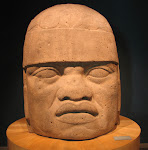
The flowering of the Olmec Civilization occurred between 1500 B.C. to 1000 B.C., when over twenty-two collosal heads of basalt were carved representing the West African Negritic racial type. This flowering continued with the appearance of "Magicians," or Shamanistic Africans who observed and charted the Venus planetary complex.
These "Magicians," are said to have entered Mexico from West Africa between 800 B.C. to 600 B.C. and were speakers of the Mende language as well as writers of the Mende script or the Bambara script, both which are still used in parts of West Africa and the Sahara.


Journeys by ship along the coast of West Africa toward the North, through the Pillars of Heracles, eastward on the Mediterran to Ports such as Byblos in Lebanon, Tyre or Sydon would have been two to three times as lengthy as taking a ship from Cape Verde, sailing it across the Atlantic and landing in North-Eastern Brazil fifteen hundred miles away, or Meso America about 2400 miles away. The distance in itself is not what makes the trip easy. It is the fact that currents which are similar to gigantic rivers in the ocean, carry ships and other vessels from West Africa to the Americas with relative ease.


The Olmec homeland is characterized by swampy lowlands punctuated by low hill ridges and volcanoes. The Olmec response to this environment was the construction of permanent city-temple complexes. The best-known Olmec centers are at San Lorenzo Tenochtitlán, La Venta, Tres Zapotes, Chalcatzingo, and La Mojarra. The Olmec were the first Mesoamericans to develop a hieroglyphic script for their language, the earliest known example dating from 650 BC.


The Olmec practiced shamanism. They believed each individual has an animal spirit. Olmec religion centered around the Shaman. "The feared and revered shaman would conduct rituals and heal the sick." Some believe that the sun was a part of their worshipping along with the jaguar.


The jaguar was a very important figure to the Olmec. "To the ancient Indians the jaguar was a symbol of supernatural forces-not a simple animal, but an ancestor and a god." It was referred to as a nahual, which is an animal that is so closely related to a certain man, that if the animal dies, the man will also die.


The Olmec were brought up believing the Great Serpent was a divine power that was believed to have brought prosperity and growth. When the Olmec first settled around the volcanoes, they noticed the dried up lava that there were resemblances to their Great Serpent, the Olmec farmers took these large basalt boulders and carved them into monuments, for example the colossal heads, and placed them in their maize fields.


Although no remains have been found of any person of the Olmec civilization, researchers have learned how they were laid to rest. After the master dies, he was laid to rest in a special burial mound in the middle of the ceremonial court. He was placed in there adorned with earrings, beads , and necklaces made of jade. Over the body, a layer of thick cinnabar red putty in the shape of an oval was spread over him with thirty-seven serpentine and jade celts. This site was then decorated on top with jewels and other decor.


However, only traces of human remains have been found. "The authors posit that the Olmecs believed that the human body, itself, and espescially that of the ruler, divided itself and represented the three cosmic levels: the celestial or heavenly, the terrestrial, the earth’s surface and the watery underworld, reachable through caves and sacred accesses."


Fine dining whenever you want to eat out in Senegambia.
A unique Gambia restaurant for both Gambian and global cuisine.
Come and enjoy our restaurant in The Gambia!
Directions Bertil Harding Highway, next to Senegambia Craft Market
220 4464022
220 6664022

gaya@qanet.gm  
gayagambia@gmail.com
www.gayaartcafe.com/


Tuesday, December 23, 2008

Africa Gambia Poetry


Gaya Art Cafe supports the arts and we encourage you to post your poetry, songs and thoughts on our weblog.
Carlos Castaneda's Teachings
Nothing in the world is a gift. Whatever there is to learn has to be learned the hard way.
Carlos Castaneda
Anything is one of a million paths. Does this path have a heart? This question is one that only a very old man asks. All paths are the same: they lead nowhere. They are paths going through the bush, or into the bush. Does this path have a heart?
If it does, the path is good; if it doesn't, it is of no use.
Both paths lead nowhere; but one has a heart, the other doesn't. One makes for a joyful journey; as long as you follow it, you are one with it. The other will make you curse your life.
One makes you strong; the other weakens you.
There's no emptiness in the life of a man of knowledge, everything is filled to the brim and everything is equal. For me there is no victory, or defeat, or emptiness. Everything is filled to the brim and everything is equal and my struggle is worth my while.
What makes us unhappy is to want. Yet if we would learn to cut our wants to nothing, the smallest thing we'd get would be a true gift. To be poor or wanting is only a thought; and so is to hate, or to be hungry, or to be in pain.
The countless paths one traverses in one's life are all equal. Oppressors and oppressed meet at the end, and the only thing that prevails is that life was altogether too short for both.
Chance, good luck, personal power, or whatever you may call it, is a peculiar state of affairs. It is like a very small stick that comes out in front of us and invites us to pluck it.
Usually we are too busy, or too preoccupied, or just too stupid and lazy to realize that that is our cubic centimeter of luck. A warrior, on the other hand, is always alert and tight and has the spring, the gumption necessary to grab it.
Any thought that one holds in mind in a state of silence is properly a command, since there are no other thoughts to compete with it.
Only as a warrior can one withstand the path of knowledge. A warrior cannot complain about, or regret, anything. His life is an endless challenge, and challenges cannot possibly be good or bad. Challenges are simply challenges.


Fine dining whenever you want to eat out in Senegambia.

A unique Gambia restaurant for both Gambian and global cuisine.
Come and enjoy our restaurant in The Gambia!
Directions Bertil Harding Highway, next to Senegambia Craft Market
220 4464022
220 6664022
gaya@qanet.gm
gayagambia@gmail.com
www.gayaartcafe.com/

Friday, August 8, 2008

Art of Meditation

This article first appeared in a magazine called Yoga International, it has been edited for this weblog.


The Raja Yoga system known as "Sahaj Marg" is still relatively obscure in the West, even among Yoga aficionados. Though its method may seem novel to some, those acquainted with the great Dharmic traditions will find Sahaj Marg a natural extension of the continuing refinement and accommodation that living yoga has always emphasized. Sahaj Marg is a practical method designed to give the direct experience of realization, right here, right now, in the midst of our daily situations.


Sahaj Marg has no credos, no dogma, no tenets. It is practical and experiential in its approach, and so members are asked not to simply believe what we hear or read, but to observe what we discover within; not to trust the claims of Sahaj Marg, but to test them as thoroughly as we can. Practice is something we do, not something we ponder. Until we realize for ourselves, all the claims of any spiritual practice are only secondhand information. So read and enjoy, do and become!


Where Religion Ends

All religions begin with the experience of God, the realization of a single person such as Christ or Buddha or Mohammed. After the founders pass on, their followers codify their teachings, and if these teachings are deep and true and helpful enough to stand the test of time, eventually they crystallize into a religion. But the original experience of its founder remains the bedrock of each religion, and to the degree that his followers can partake of that experience themselves, the religion remains valid and transformative, rather than degenerating into a set of mechanical rituals or a dry body of moral rules and social expectations.


Sahaj Marg also affirms the necessity of a realized Master in human form to assist most people in their journey Home. A true Master comes to serve, not rule, for as my Master's own Master taught, "God is the real Guru or Master and we get light from Him alone. But as it is extremely difficult for a man of ordinary talents to draw inspiration from God directly, we seek the help of one of our fellow beings who has established his connection with the Almighty." In Sahaj Marg, "Master" simply refers to one who has mastered himself, and who has the ability to make Masters like himself. Thus, though the Masters of the Sahaj Marg lineage are each unique in terms of physique, personality, taste, and temperament, in their most essential Nature they are one and the same person.


Tradition and Transformation
Sahaj Marg is usually presented as a refinement of Raja Yoga. Ultimately, however, it must be understood as a distillation of the yogas of Jnana, Karma,Bhakti and Raja as well.


These four yogas arrive at a place where all paths end and merge, which we may call whatever we please, since words don't matter at this point: the kingdom of God, the Source, the Center, or the Impersonal Absolute. This is why Vivekananda advised yogis to be like a bird, have Bhakti Yoga as one wing, Jnana Yoga as the other wing, and Raja Yoga as the guiding tailfeathers.


Sahaj Marg reminds us that yoga, and in particular Raja Yoga, is a not and never was a frozen practice, fixed at some point in the distant past and codified by Patanjali around the Second Century AD in his Yoga Sutras. Even the highest concepts and most honored methods must evolve as the situations of men change. Methods which were suitable for a bull-cart society may not be so suitable in the vastly different world of the late 20th Century. 


Those acquainted with Raja Yoga will be familiar with Patanjali's Eight Limbs, the Ashtanga steps of Raja Yoga. These have usually been viewed as steps leading to the final union of self with Self, of human with divine -- which is what the word yoga, or "yoke," implies. Whether Patanjali ever intended his "Eight Limbs" to be considered as sequential and consequential stages is debatable, but Sahaj Marg takes a simultaneous and global approach to the practice of Raja Yoga.


The Circumference is Nowwhere
Contrary to some notions, Sahaj Marg teaches that meditation is easy and requires no preliminary steps for anyone who has a normal state of mental health -- in fact, Sahaj Marg teaches that only by meditating can we learn to meditate. The psychologically dangerous aspect of Pranayama has been superseded in Sahaj Marg by Pranahuti (prana-ahuti, literally "offering Prana"), by which an individual can transmit spiritual reality directly from the center of his or her existence to the center of another individual's existence.


The yogic transmission of subtle or Divine energy by one whose own life-force, or Prana, is realized at such a high vibratory level that it can awaken the dormant Prana in others across any distance by the merest thought or Sankalpa was known to adepts in the distant past, but had fallen into a sort of honored desuetude until it was re- discovered as a useful technique for 20th Century by Shri Ram Chandra of Fatehgarh (1873-1931).


The art of Pranahuti was transmitted by Lalaji to his most fit disciple, who by coincidence also bore the name Ram Chandra. This disciple, now known as Shri Ram Chandra of Shahjahanpur (or more simply as Babuji, since he worked all his life as a "babu," or clerk) perfected the practices of Sahaj Marg, distilling a natural and simple method of meditation from the traditional procedures of Raja Yoga, established the Shri Ram Chandra Mission in 1945 in honor of his guru, and upon his death or Mahasamadhi in 1983 transmitted his essence to his disciple, Shri Parthasarathi Rajagopalachari.


The Centre is Everywhere
Sahaj Marg insists that the highest spiritual attainments can be realized by anyone at any time in any place. In recognition of this understanding, Pranahuti or yogic transmission can be received not only directly from the Master, who is an adept in the art, but also via preceptors who have been personally prepared by the Master to serve as conductors of Pranahuti. Over 900 preceptors now serve worldwide. These preceptors can be likened to transformers in neighborhoods that direct and regulate the energy from a distant power plant for individual use. Preceptors are themselves abhyasis (practitioners) who are still evolving at varying levels of spiritual maturity.


The Simple Way
What, then, does one actually do in Sahaj Marg? According to the teachings of Sahaj Marg, God is simple, and the Way to God may also be simple. Thus there are no rituals in Sahaj Marg. Do's and don'ts are few. There are no secret mantras or mudras, no arcane Asanas, no special clothes, no changing of names. Really, there is nothing about Sahaj Marg to believe or disbelieve, because the practice involves direct experience. Sahaj Marg asks us not to believe, but to observe; not to trust, but to test.


The daily abhyas or practices are quite simple. The abhyasi is asked to sit comfortably and meditate at the beginning of the day for at least 30 minutes, eventually for an hour if possible, focusing on the heart (a preceptor can detail the method).


At the end of the day, sit again for at least 30 minutes, but this time, the purpose is for cleaning, and again the technique is quite simple. Weekly Satsanghs or group meditations are helpful, along with individual sittings from preceptors. Abhyasis are encouraged to keep a diary of their inner life, and most soon notice a feeling of Shanti or peace, a sense of lightness, and an awakened intuitive ability.


So the basic practice takes about one or two hours a day -- we begin our day with meditation, end it with another, and enter sleep in a state of prayer. By an art called "Constant Remembrance" the abhyasi can eventually extend these meditations to 24 hours a day. Curiously enough, many find that the simplicity of the practice is its major difficulty, especially since Sahaj Marg claims to aim for a level of human perfection beyond that which even Patanjali described. This claim can be easily tested, for Sahaj Marg was designed so that even the busiest person could integrate a profoundly transformative spiritual practice into his or her daily life.


This brief description of Sahaj Marg is little more than a menu, and though reading a menu may whet the appetite, it can hardly satisfy the stomach.


Fine dining whenever you want to eat out in Senegambia.

A unique Gambia restaurant for both Gambian and global cuisine.
Come and enjoy our restaurant in The Gambia!
Directions Bertil Harding Highway, next to Senegambia Craft Market
220 4464022
220 6664022
gaya@qanet.gm
gayagambia@gmail.com
www.gayaartcafe.com/