Showing posts with label gambia cuisine. Show all posts

Tuesday, November 10, 2009

Visit Senegal


Senegal lies between the Tropic of Cancer and the Equator and enjoys a steady warm year round climate, with a short rainy season between the months of June and September.

As such it provides the perfect weather for a lazy beach holiday, especially in the Saly region just south of Dakar; but Senegal also has three mighty rivers and these provide a good deal of fertile land and some wonderfully intricate coastal lagoons and waterways that are a joy to explore. 

And because of this abundance of water and fertility it supports a great wealth of wildlife including numerous birds from coastal waders to large raptors, and various mammal species such as warthogs, hyenas, monkeys, baboons, manatees and dolphins.

CLIMATE
Senegal has marked contrasts in climate. The coastal region, except in Casamance, is equable, with low rainfall and high humidity. Inland, the climate is drier, ranging to the semi-desert of the Sahel region in the east. The wet season is from June to September, rather shorter in the north and longer in the south, especially near the coast.

VISAS & IMMIGRATION
Citizens of countries member of the European Union (EU) do not need visa to travel to Senegal for up to three months stay. Visas are also not required for citzens of Canada Israel Japan Taiwan United States .


PEOPLE
The population was estimated in 2002 at about 9,8 millions , of which a quarter live in the agglomeration of Dakar, it is composed of many ethnics. 

The Wolofs, are the most represented (35%), they make up the majority in all the regions, especially in the centre, the north and the coast of Dakar and Saint Louis. The farmers and the merchants, of Muslim faith for the majority, there importance is certain in the nations economy. The Lebous, established in fishing communities in the peninsula of Cap-Vert and in Saint Louis are related.

 The Pulaar (20%), is composed of the Foulbes, Peuls and Toucouleurs, in the northern Senegal, the Fouta Toro, historical source for the propagation of Islam in Senegal, make up the cultural birthplace, they are very active in the commercial domain, as well as breeding and irrigated farming. they populate the Senegalese river valley and the Ferlo region. 

The Sereres (17%) are less scattered out than the other ethnic groups. They can be found in the Sine-Saloum, along the Small Coast, in the centre of countries and north-west of the Gambia. The majority are Muslim, except for those along the Small Coast. The Diolas (10%) can be found in the Casamance, but also in Gambia and the Guinea-Bissau. Oriented rather to the culture of rice, they are for the majority animist and/or Christians in the basse Casamance region (Ziguinchor, Oussouye, Cap Skiring), and musulmans in the north and east. 

Other than the main ethnic groups, we find the Mandingues of Eastern Senegal, the Soninkes very present in the east of the country and in the zones adjacent to the Mali and the Mauritania, the Bassari which live mainly by the culture of the millet and corn, of the picking and hunting, between the Guinea border and the limit of the Niokolo-Koba national park.
You may already be a fan of Senegalese music, or you may well already be a fan of Senegalese music without realising it. For a relatively small country they have produced a startling amount of fabulous music, and much that has crossed over the ‘world music’ divide into the consciousness of Western musical audiences.

Naming CeremoniesWood Carvings
These are great lively occasions that are well worth a look if you have the opportunity. This normally takes place one week after the child is born. The elders of the village gather together in the morning and name the baby whilst slaying either a chicken, goat, sheep or cow depending on the wealth of the family. Then the rest of the village is invited to join in and the party continues long into the night. There are displays of dancing and singing and collections for the new baby continue throughout the event - so we recommend that if ever invited you take along plenty of small notes.


Tabaski
Tabaski is probably the most important celebration in the Muslim calendar and is marked by a two-day public holiday. Muslims kill a ram to commemorate when Abraham was about to sacrifice his son Isaac in obedience to God.

Ramadan
This is a 30-day festival that takes place each and every year in the ninth month of the lunar calendar. During this period all physically mature and healthy Muslims are obliged to abstain from all food, drink, gum chewing and any kind of tobacco use.

Ramadan is a time for spiritual reflection, prayer, doing good deeds and spending time with family and friends. The fasting is a way of experiencing hunger and developing sympathy for the less fortunate, and learning to thank and appreciate all of God's bounties.

MUSIC
A few names for you: Youssou N’Dour, Baaba Maal, Orchestra Baobab – and these are just the artists that have made that crossover; you’ll find that music is such a presence in Senegal, and such a crucial part of the very fabric of life that it will form a soundtrack to your holiday, a soundtrack for your memories.


SENEGAL ATTRACTIONS

The Bandia Nature Reserve
Is a small but perfectly formed game reserve, situated 40 miles from Dakar near Saly and M’bour.

You can enter the reserve either in your own car or in one of the Reserve’s 4WD vehicles and hire the services of one of the skilled guides to see some typical African savannah animals: Giraffe, White Rhino, Zebra, Roan Antelope, Waterbuck, Kudu, Oryx, Impala, Cape Eland, Lord Derby Eland, Kob Antelope, West African Forest Buffalo, Wart Hog, Crocodiles, Green Vervet Monkeys and Patas Monkeys.

Dakar
Is the capital of Senegal, located on the Cape Verde Peninsula, on the country's Atlantic coast. It is Senegal's largest city. Its position, on the western edge of Africa, is an advantageous departure point for trans-Atlantic and European trade; this fact aided its growth into a major regional port.

Kermel Market
Many women go to the colourful Kermel Market to sell a variety of flowers: marigolds, zinnias and sunflowers. The flowers are primarily for western tourists. At Kermel Market, a hot spot for foreign visitors from the West and Asia, vendors have been selling their goods since the beginning of the twentieth century.

Lac Rose
Lac Rose (The Pink Lake) surrounded by dunes, is a large shallow lagoon 10 times saltier than the ocean and is renowned for its pink hue when the sun is high. The colour is due to a high concentration of minerals in the water. Senegal’s answer to the Dead Sea, you can swim here or effortlessly float on the surface. There is a small-scale salt-collecting industry on the southern side of the lake which is also worth a visit.

Marche Sandanga
The Marche Sandanga (Sandanga Market) is a labrynth of stalls selling anything from Senegalese music casettes to freshly plucked chickens. You can buy just about anything here, although don’t expect too many souvenir stalls. Colourful and vibrant cloth and clothing are a major attraction of this traditional market, drawing in many visitors.

Palais Présidential
The Palais Présidentiel (Presidential Palace) is a white building dating back to 1906 and encompassing strikingly lovely gardens. Guards in their Presidential uniforms guard the outside and pose with tourists for pictures.

Village Artisanal
One of the most popular places for buying souvenirs is the government-sponsored Village Artisanal (Village of Traditional Handicrafts), near the fishing beach of Soumbédioune. You'll find a tremendous display of wooden carvings, metal work, gold and silver jewellery, ivory, tablecloths, blankets, leather goods and clothing, but a lot of the goods are turned around very quickly and you have to search hard for good-quality pieces.

GOREE ISLAND
To the east of Dakar, about 3km offshore, is Île de Gorée, one of the earliest European settlements along this part of coast. Today it is a haven of history and peace within easy reach of Dakar via ferry which departs every two hours during the daylight.

Local Art & Crafts
You will find a variety of traditional vibrant, colourful fabrics and canvasses, together with wooden carvings and instruments on display on the island produced by local artists.

The Old Slave Trading Station
With its colonial brick-structures and sand-blown, bougainvillea-flushed alleyways, this island is a haven of tranquillity. But there's a sad background to all this calm beauty - Île de Gorée used to be an important slave trading station, and many visitors come here for traces of this tragic past. Maison des Esclaves (Slave House) is a museum dedicated to the slave era.

The Fort
The Fort stands as a reminder of the Second World War. Here visitors can see a memorial statue and the original heavy metal war guns, and view a red buoy out in the sea marking where a British ship was sunk by the guns during the war. You can find out more about the effects of the war on Gorée Island by visiting the island’s museum of history. There is also the opportunity to visit a traditional African mosque.

SAINT LOUIS
The Saint Louis region of Senegal sits just off the border with Mauritania. Famous for its cast iron bridge, put in by French colonialists in the 19th century, it is close to the Djoudj National Park, home to thousands of birds, some indigenous to the area. The city is also famed for its culinary roots, being the home to Senegal's national dish: Ceb-u-djen - rice and fish.

The Governor’s Palace
The Governor’s Palace is an 18th century fort, and now a government building. Place Faidherbe, with its statue of the famous French colonial governor, sits in front of the Governor’s Palace.

Guet N’Dar Fishing Village
In the fishing part of the town, Guet N’Dar, pirogues are lined up on the beach and fish dry on racks by the side of the road. Women boil up fish in vast drums, and the steam mixes odorously with the early morning sea mist. A little further south is the Muslim cemetery, where each fisherman’s grave is covered with a fishing net.

Réserve de Faune de Guembeul
This reserve is small, accessible and easy to explore by foot. It’s about 8 miles south of St Louis. The landscape is a mixture of lagoons, mud flats and dry woodland protecting the population of endangered Sahel animals, which include Dama Gazelles, Patas Monkeys and Sulcata Tortoises. There are also many birds around the lagoon – 190 species have been spotted here – and there are plans to introduce other Sahel mammals into the reserve.


Ebony is an exceptionally hard and beautiful wood found only in the Sahara desert regions of Africa. Its exceptional density makes it not only very heavy, but also gives it an incomparable sheen when polished. West Africa is home to many master carvers of ebony. 

Fine dining whenever you want to eat out in Senegambia.

A unique Gambia restaurant for both Gambian and global cuisine.
Come and enjoy our restaurant in The Gambia!
Directions Bertil Harding Highway, next to Senegambia Craft Market
220 4464022
220 6664022

Sunday, November 1, 2009

Gambia Fine Dining


We all want to eat well when we are on a holiday and Gambian cuisine is famous for integrating cross-cultural elements and serving up something exquisite.

The local dishes are prepared with an eye for detail and you are bound to find some of them perfect for your taste. For those who seek the comfort of the familiar there are restaurants that offer a variety of dishes from English, French, Italian and Spanish cuisines.

Fine dining  with a twist.
The idea of the Gaya Art Cafe was in development over many years through the proprietors world wide travels and observations of many cultures.
Continental European
Blend of fresh organic dishes with a twist. A selection of tapas, salads, freshly baked foccacias and tortilla. There is also a variety of freshly roasted coffee beans from other countries.

Fine dining whenever you want to eat out in Senegambia.
A unique Gambia restaurant for both Gambian and global cuisine.
Come and enjoy our restaurant in The Gambia!
Directions Bertil Harding Highway, next to Senegambia Craft Market
220 4464022
220 6664022

Saturday, October 24, 2009

Benachin


Cooking Ingredients:
1. 2 lbs fresh fish
2. 2 cups of vegetable oil
3. 6 cups of water
4. 1 medium fresh tomato
5. 4 tbsp tomato paste
6. 2 large onions
7. 1 small cabbage
8. 2 medium carrots
9. 1 bay leaf
10. 4 cups of rice
11. Salt and pepper to taste


Cooking Method:
1. Clean and cut fish in halves.
      
2. Fry the fish in the vegetable oil until both sides are brown.
      
3. Remove fish and add onions, fresh tomato and paste to the hot oil and fry until brown.
      
4. Pour water and bring to boil, then include cabbage, carrots, bay leaf, and seasonings, reduce heat and simmer for 20 mins.
      
5. Remove vegetables and add the rice while continuously stirring.
      
6. Reduce heat and cover the pot. Simmer for 10 mins.
      
• Benachin is sometimes referred to as cheebu / chebu jen in Senegalese.

Fine dining whenever you want to eat out in Senegambia.  
A unique Gambia restaurant for both Gambian and global cuisine.
Come and enjoy our restaurant in The Gambia!
Directions Bertil Harding Highway, next to Senegambia Craft Market
220 4464022
220 6664022
gaya@qanet.gm
gayagambia@gmail.com
www.gayaartcafe.com/

Sunday, October 18, 2009

Gambian Spinach Stew - Plasas


Cooking Ingredients:
1.     2 packages frozen chopped spinach
2.     1 pound meat stewing beef
3.     1/2 pound smoked fish, flaked
4.     2 hot chili peppers
5.     1 large onion, chopped
6.     1/4 cup groundnut paste (peanut butter)
7.     3 cups water
8.     1-1/2 cups palm oil

    Cooking Method:
1. Cut meat into bit-size portions.
      
2. Put in saucepan with two cups of water, salt, chopped onions and peppers.
      
3. Bring to boil and add palm oil.
      
4. Continue cooking partly covered. Cook for 1-1/2 hours over medium heat.
      
5. Add spinach (previously thawed and drained), flaked fish and groundnut paste mixed with water.
      
6. Stir, cover and simmer for 10 minutes.
      
The recipe is served with steamed rice.

Fine dining whenever you want to eat out in Senegambia.  
A unique Gambia restaurant for both Gambian and global cuisine.
Come and enjoy our restaurant in The Gambia!

Directions Bertil Harding Highway, next to Senegambia Craft Market
220 4464022
220 6664022
gaya@qanet.gm
gayagambia@gmail.com
www.gayaartcafe.com/

Friday, October 9, 2009

Gambia Food Dishes


Traditional Gambian dishesJollof Rice, Benachin cooked in homes are mostly rice, the staple food, with a covering of various spicy sauces as on the right. However, steamed millet, couscous, cassava is also eaten.

The defining ingredients for these various dishes are either peanut butter paste (Domoda), ladies fingers (Okra), palm oil (chew deu terr) or edible leaves such as spinach or cassava leaves. Very popular among poor families is Mbahal which is rice mixed with grated peanuts, dried fish such as bonga. Many of these dishes are also common to Senegalese cooking as both countries have common cultural ties.

Some of the best known dishes are 'Domoda' (peanut butter sauce), 'supakanja' (okra stew), 'benachin' (Jolof Rice), 'Chere' (couscous type millet), chicken 'Yassa' (fried chicken in onions). Lunch is usually cooked for a couple of hours until the meat is well cooked - though for fish dishes, the fish may be removed after a short cooking time and replaced towards the end of the cooking time.

Most urban Gambians eat bread, butter and/or jam for breakfast. People may also have 'Chura Gerrte' (rice and peanuts - boiled) or 'ruy' (pap), with added yoghurt or tinned milk. For the majority of Gambians afternoon lunch is the most important meal of the day.

The main staple dish in The Gambia is rice with a choice of stew - made with either fish, chicken, beef, lamb or goat - usually cooked with vegetables, spices and sometimes peanut butter. Pork is NOT on the menu for 90 percent of Gambians who are Muslims, though it is available for Christians in many supermarkets and from specialised pig breeders.

Lunch is served in a large, common food bowl next to which the diners sit on the floor or a wooden stool. When eating you use your right-hand (washed), though many urban men (and some women) may use a spoon.

For dinner people eat either fried fish, oysters, shrimps, chicken and fried beef with onions. These may then be served with salad and / or bread or couscous. Others may have 'Chura Gerrte' or 'Ruy' (Coos porridge).

Increasingly Gambians are eating more convenience foods, particularly in the evenings, and this has begun to lead to health problems associated with high blood pressure, heart disease and diabetes.

Jumbo and Maggi cubes are similar to bouillon cubes, and are widely used to season all types of Gambian dishes and fare, from sauces to sandwiches.
Fine dining whenever you want to eat out in Senegambia.  
A unique Gambia restaurant for both Gambian and global cuisine.
Come and enjoy our restaurant in The Gambia!

Directions Bertil Harding Highway, next to Senegambia Craft Market
220 4464022
220 6664022
gaya@qanet.gm
gayagambia@gmail.com
www.gayaartcafe.com/

Tuesday, September 29, 2009

African Gifts


We have many smaller gift items: beautiful scented candels, napkin holders,incense gift sets, picture frames and much more.
We will wrap your gift beautifully for that special person in your life.

Fine dining whenever you want to eat out in Senegambia.

A unique Gambia restaurant for both Gambian and global cuisine.
Come and enjoy our restaurant in The Gambia!
Directions Bertil Harding Highway, next to Senegambia Craft Market
220 4464022
220 6664022
gaya@qanet.gm
gayagambia@gmail.com
www.gayaartcafe.com/

Thursday, September 24, 2009

Superkanja


Cooking Ingredients:
1. 2lbs of lean beef
2. 1lb smoked fish
3. 2 cups palm oil
4. 2lbs cut okra
5. 1/4tsp of baking powder
6. 2 large onions chopped
7. 8 cups water
8. Salt and pepper to taste

  Cooking Method:
1. Wash and cut meat into bite size pieces.
      
2. In a large pan, boil fish and meat in water for 15 minutes, then remove the fish.
      
3. Add onions, salt, pepper and okras.
      
4. Simmer for 15 minutes and then add palm oil.
      
5. Reduce heat and simmer for 20 minutes stirring occasionally.
      
6. Add fish and continue simmering in low heat for 10 minutes. Serve with plain boiled rice or Fufu.

Fine dining whenever you want to eat out in Senegambia.  
A unique Gambia restaurant for both Gambian and global cuisine.
Come and enjoy our restaurant in The Gambia!

Directions Bertil Harding Highway, next to Senegambia Craft Market
220 4464022
220 6664022

gaya@qanet.gm
gayagambia@gmail.com
www.gayaartcafe.com/

Monday, September 14, 2009

Gambia Artist Buba Drammeh

Buba Drammeh is a talented batik artist from The Gambia. His batiks have been incorporated in the design for the CD "Mansalou", featuring the kora playing and singing of Jali Sherrifo Konteh.

Batik is a way of decorating cloth by covering part of it with a coat of wax and then dyeing the cloth. This process is usually repeated several times, using different dyes, until the final effect is achieved. The waxed area keeps its original colour and when the wax is removed the contrast between the dyed and undyed areas makes the pattern. During the dyeing the brittle nature of the dried wax will cause it to crack, allowing small quantities of dye to penetrate to the cloth. The resulting spider-web pattern adds an unplanned and interesting effect to any design and is a special characteristic of most batik work.

Buba normally buys his cloth, which is usually white or a very light colour, from the town of Serrakunda. He buys whatever amount of cloth he can afford, together with the dyes, salt, caustic soda and wax crayons.


Then he cuts the cloth according to the size of the pattern he has decided to draw. He spreads the cloth flat and draws straight onto the cloth (which is always 100% cotton) using a crayon which is not the same colour as the first dye. If the same colour were to be used the pattern would not been seen when it came out of the dye


He then melts the candle wax and uses a small stick with wire wrapped round it, called a tjanting, to dip in the wax. The wire will hold the wax and will permeate and seal the parts of the cloth it covers so that the dye cannot penetrate. He paints the melted wax onto the parts of the cloth he wants to remain white.

Next he prepares the dye-bath, mixing the salt and caustic soda with the dye powder, using gloves to protect his hands from the caustic soda. The soda and salt helps to fix the colour to the cloth. The first colour will be the lightest colour he wants to use. He then puts the material to dry but has to take care not to leave it in the hot sun for too long as it could melt the wax!


When the cloth is dry the wax is melted again and those areas that are to retain the colour just dyed are covered with wax, and the material is dipped into a dye of a colour darker in tone than the first. This process continues until the darkest shade (black) has been reached. There are usually five or six colours in the final batik, including the original white of the material and the final black. Since the colours are superimposed in the dyeing process, a particular colour-scale must be planned. For example, if the first colour was blue, then yellow could be used for the second dye and that would make green, or red to make brown.

Finally Buba buys firewood and builds a small fire to boil water, soap and salt together in a big container and the boiling water will take the wax out of the cloth. Then it is washed and ironed. The ironing will remove any final small particles of wax from the material. He has no electricity so the iron is a flat iron that holds heated charcoal in the top.


Buba syeas he gets the ideas for his designs from he said that he likes to promote the traditional African way of life. Things that his forefathers would also have done, such as hunting, fishing and pounding (rice and other grains), and also scenes of life in a compound or traditional musicians such as a kora , balafon or djembe player. He has also heard stories from his mother and grandmother, perhaps about an animal, and he will draw that, so, as he says, "Children can come and say, oh, look these animals are existing in The Gambia." He also gets ideas and colour schemes just by "looking at what is around me". This of course, includes the Baobab tree, which can live for hundreds of years, and is a very important tree in The Gambia. People depend on it for food and for cures and many believe it has magical properties.

Buba Drammeh was born at Nuimi Nemakunku village, in the Upper Nuimi district on North Bank. His father's name was Saikou Ba Drammeh, who was a hunter. He died very early but Buba has been told that he was a hunter of crocodiles and other creatures. His mother's name is Jankang Nass, now married again and living in Nuimi Lamin where Buba now lives with his wife, three children, adopted nephew, parents, sisters and other friends. There is a large and very productive vegetable garden which is run as a co-operative by all the hard-working women.


Fine dining whenever you want to eat out in Senegambia.  
A unique Gambia restaurant for both Gambian and global cuisine.
Come and enjoy our restaurant in The Gambia!
Directions Bertil Harding Highway, next to Senegambia Craft Market
220 4464022
220 6664022

Wednesday, September 9, 2009

African Mystery of the Olmecs


More than 1,500 years before the Maya flourished in Central America, 25 centuries before the Aztecs conquered large swaths of Mexico, the mysterious Olmec people were building the first great culture of Mesoamerica. Starting in 1200 B.C. in the steamy jungles of Mexico's southern Gulf Coast, the Olmec's influence spread as far as modern Guatemala, Honduras, Belize, Costa Rica and El Salvador.


They built large settlements, established elaborate trade routes and developed religious iconography and rituals, including ceremonial ball games, blood-letting and human sacrifice, that were adapted by all the Mesoamerican civilizations to follow.


The Olmecs were the first Mesoamerican people to fathom the concept of zero, maintain a calendar, and use a hieroglyphic writing system based on the Manding system of West Africa. These intellectual achievements, as well as Olmec myths and rituals, were influential in the subsequent Maya, Zapotec, and Aztec cultures.


Studies done by researchers such as Ivan Van Sertima (They Came Before Columbus), Alexander Von Wuthenau (Unexpected Faces in Ancient America), Runoko Rashidi and others have presented evidence that clearly show that the Olmecs were Africans from the Mende regions of West Africa .


Studies done by Clyde Winters show that the Olmecs used the Mende script, a writing system used among the Mandinkas and other Africans in West Africa . When the writings on Olmec monuments were translated, it was found that the language spoken by the Olmecs was Mende.


The Olmecs practiced a religion and astronomical sciences identical to those practiced by Africans in the Mali region and Nigeria today. The Olmecs studied the Venus Complex in astronomy. Today, the Ono and Bambara who are famous sea and river travelers have studied that same complex for thousands of years. In fact, another group the Dogon is well known for their tracking and mapping of the Sirius star system and their accurate results.


The Olmecs also had a religious practice of Thunder worship where the ax was a prominent feature. In West Africa , the ax is also a prominent feature in connection with the Shango or Thunder God worship. Both the Olmecs and the Shango worshippers in West Africa placed an emphasis on the religious significance of children in their religious practices.


The earliest trade and commercial activities between prehistoric and ancient Africa and the Americas may have occurred from West Africa and may have included shipping and travel across the Atlantic. The history of West Africa has never been properly researched. Yet, there is ample evidence to show that West Africa of 1500 B.C. was at a level of civilization approaching that of ancient Egypt and Nubia-Kush.


The Olmecs used an African practice that is very common in Africa and to some extent in Melanesia . That practice is body scarification and specifically facial scarification as practiced in West Africa . Many of the facial scars seen on the Olmec terracotta faces, such as "dot" keloids and "lined" patterns are identical to Africans such as the Dinka of Sudan and the Yoruba and others of West Africa .


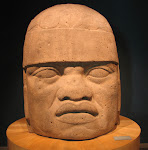
The flowering of the Olmec Civilization occurred between 1500 B.C. to 1000 B.C., when over twenty-two collosal heads of basalt were carved representing the West African Negritic racial type. This flowering continued with the appearance of "Magicians," or Shamanistic Africans who observed and charted the Venus planetary complex.
These "Magicians," are said to have entered Mexico from West Africa between 800 B.C. to 600 B.C. and were speakers of the Mende language as well as writers of the Mende script or the Bambara script, both which are still used in parts of West Africa and the Sahara.


Journeys by ship along the coast of West Africa toward the North, through the Pillars of Heracles, eastward on the Mediterran to Ports such as Byblos in Lebanon, Tyre or Sydon would have been two to three times as lengthy as taking a ship from Cape Verde, sailing it across the Atlantic and landing in North-Eastern Brazil fifteen hundred miles away, or Meso America about 2400 miles away. The distance in itself is not what makes the trip easy. It is the fact that currents which are similar to gigantic rivers in the ocean, carry ships and other vessels from West Africa to the Americas with relative ease.


The Olmec homeland is characterized by swampy lowlands punctuated by low hill ridges and volcanoes. The Olmec response to this environment was the construction of permanent city-temple complexes. The best-known Olmec centers are at San Lorenzo Tenochtitlán, La Venta, Tres Zapotes, Chalcatzingo, and La Mojarra. The Olmec were the first Mesoamericans to develop a hieroglyphic script for their language, the earliest known example dating from 650 BC.


The Olmec practiced shamanism. They believed each individual has an animal spirit. Olmec religion centered around the Shaman. "The feared and revered shaman would conduct rituals and heal the sick." Some believe that the sun was a part of their worshipping along with the jaguar.


The jaguar was a very important figure to the Olmec. "To the ancient Indians the jaguar was a symbol of supernatural forces-not a simple animal, but an ancestor and a god." It was referred to as a nahual, which is an animal that is so closely related to a certain man, that if the animal dies, the man will also die.


The Olmec were brought up believing the Great Serpent was a divine power that was believed to have brought prosperity and growth. When the Olmec first settled around the volcanoes, they noticed the dried up lava that there were resemblances to their Great Serpent, the Olmec farmers took these large basalt boulders and carved them into monuments, for example the colossal heads, and placed them in their maize fields.


Although no remains have been found of any person of the Olmec civilization, researchers have learned how they were laid to rest. After the master dies, he was laid to rest in a special burial mound in the middle of the ceremonial court. He was placed in there adorned with earrings, beads , and necklaces made of jade. Over the body, a layer of thick cinnabar red putty in the shape of an oval was spread over him with thirty-seven serpentine and jade celts. This site was then decorated on top with jewels and other decor.


However, only traces of human remains have been found. "The authors posit that the Olmecs believed that the human body, itself, and espescially that of the ruler, divided itself and represented the three cosmic levels: the celestial or heavenly, the terrestrial, the earth’s surface and the watery underworld, reachable through caves and sacred accesses."


Fine dining whenever you want to eat out in Senegambia.
A unique Gambia restaurant for both Gambian and global cuisine.
Come and enjoy our restaurant in The Gambia!
Directions Bertil Harding Highway, next to Senegambia Craft Market
220 4464022
220 6664022

gaya@qanet.gm  
gayagambia@gmail.com
www.gayaartcafe.com/


Saturday, August 1, 2009

Art In The Gambia

The Gambia is the smallest country in Africa. It follows the banks of the River Gambia to the Atlantic Ocean. It is completely surrounded by Senegal except along its western coastal margin. There are just over 1.5 million people, with many different tribal groups speaking different local languages as well as English, French and Arabic.
Compared to some of its near neighbours in West Africa, The Gambia has created few artistic ethnographic objects. Most villages had blacksmith-craftsmen, but the cultural area with huge expertise stretching across the generations and down through the centuries was that of music and oral traditions.
Musicians played drums and the kora (a complex stringed instrument). Griots, storytellers and poets who preserved knowledge of ancestors and of oral traditions, were vital guardians of the culture. However, recent decades have seen a sudden blossoming in the visual arts and the emergence of a number of internationally respected artists.
There are four really well-known Gambian visual artists who have exhibited widely, both within The Gambia and internationally.
They are:
Njogu Touray whose work we have shown for three years. You can see examples of his work and read his biography in our gallery.
Momodou Ceesay, painter and printmaker, residing in Bakau where he has his own gallery showing his work and works by upcoming young artists he has personally selected. He spent many years in the United States and is using his good connections to promote the arts in The Gambia, working especially with schoolchildren.
Alhajie Bubacarr Badgie, a well-known painter, who we have not yet met unfortunately as he was in the United States when we visited.
Edrisa Jobe, a painter living and working in Katchikally.
There are many young artists emerging in The Gambia today and who are benefiting from the surge in interest and support that stems from both the growth in tourism and international development aid.
As in many African countries, the Alliance-Francais has been particularly active in its support and has organised and/or hosted numerous exhibitions. All the artists listed above were included in their 2002 exhibition Art From The Gambia, which helped define the current state of the visual arts in the country.
A number of galleries have also sprung up - the Village Gallery, African Heritage, Gaya Art galleries and the major hotels often show high quality work.


Fine dining whenever you want to eat out in Senegambia.

A unique Gambia restaurant for both Gambian and global cuisine.
Come and enjoy our restaurant in The Gambia!
Directions Bertil Harding Highway, next to Senegambia Craft Market
220 4464022
220 6664022
gaya@qanet.gm  
gayagambia@gmail.com
www.gayaartcafe.com/

Wednesday, July 29, 2009

Gaya Art Cafe


The Cafe
Flavours of the Mediterranean, Latin America and Asia. Great cocktails, freshly ground coffee from around the globe and delicious cakes. Ecelptic ambience, Wi-Fi Internet, catering services, take-aways and much more!
The Gallery
We cater to all budgets. Great selection of African Art, unique gifts, custom jewellery, furniture, and lots more. Interior decoration srervices available.

Fine dining whenever you want to eat out in Senegambia.  
A unique Gambia restaurant for both Gambian and global cuisine.
Come and enjoy our restaurant in The Gambia!
Directions Bertil Harding Highway, next to Senegambia Craft Market
220 4464022
220 6664022
gaya@qanet.gm
gayagambia@gmail.com
http://www.gayaartcafe.com/

Friday, July 24, 2009

Press Release


The Gaya Art Cafe in Senegambia is a magnificently decorated treasure trove showcasing a beautiful collection of African artefacts and work from local crafts people.
It doubles up as a cafe-restaurant serving tapas, healthy salads and delicious freshly baked bread, perfectly complemented by a superb selection of freshly ground coffee beans from around the world.


SN BRUSSELS IN-FLIGHT MAGAZINE
Directions Bertil Harding Highway, next to Senegambia Craft Market
220 4464022
220 6664022
gaya@qanet.gm
gayagambia@gmail.com
www.gayaartcafe.com/

Tuesday, June 16, 2009

African Interior Design


Gaya Art Cafe stock a range of lamps, cushion covers, and many other one off items to give a beautiful touch of elegance and sophistication to your home. Selection allows for most budgets.
We also have an interior design consultancy service available for all your home decorating needs.


Fine dining whenever you want to eat out in Senegambia.

A unique Gambia restaurant for both Gambian and global cuisine.
Come and enjoy our restaurant in The Gambia!
Directions Bertil Harding Highway, next to Senegambia Craft Market
 220 4464022
220 6664022
gaya@qanet.gm  
gayagambia@gmail.com
www.gayaartcafe.com/