They built large settlements, established elaborate trade routes and developed religious iconography and rituals, including ceremonial ball games, blood-letting and human sacrifice, that were adapted by all the Mesoamerican civilizations to follow.
The Olmecs were the first Mesoamerican people to fathom the concept of zero, maintain a calendar, and use a hieroglyphic writing system based on the Manding system of West Africa. These intellectual achievements, as well as Olmec myths and rituals, were influential in the subsequent Maya, Zapotec, and Aztec cultures.

Studies done by researchers such as Ivan Van Sertima (They Came Before Columbus), Alexander Von Wuthenau (Unexpected Faces in Ancient America), Runoko Rashidi and others have presented evidence that clearly show that the Olmecs were Africans from the Mende regions of West Africa .
Studies done by Clyde Winters show that the Olmecs used the Mende script, a writing system used among the Mandinkas and other Africans in West Africa . When the writings on Olmec monuments were translated, it was found that the language spoken by the Olmecs was Mende.

The Olmecs practiced a religion and astronomical sciences identical to those practiced by Africans in the Mali region and Nigeria today. The Olmecs studied the Venus Complex in astronomy. Today, the Ono and Bambara who are famous sea and river travelers have studied that same complex for thousands of years. In fact, another group the Dogon is well known for their tracking and mapping of the Sirius star system and their accurate results.
The Olmecs also had a religious practice of Thunder worship where the ax was a prominent feature. In West Africa , the ax is also a prominent feature in connection with the Shango or Thunder God worship. Both the Olmecs and the Shango worshippers in West Africa placed an emphasis on the religious significance of children in their religious practices.
The earliest trade and commercial activities between prehistoric and ancient Africa and the Americas may have occurred from West Africa and may have included shipping and travel across the Atlantic. The history of West Africa has never been properly researched. Yet, there is ample evidence to show that West Africa of 1500 B.C. was at a level of civilization approaching that of ancient Egypt and Nubia-Kush.
The Olmecs used an African practice that is very common in Africa and to some extent in Melanesia . That practice is body scarification and specifically facial scarification as practiced in West Africa . Many of the facial scars seen on the Olmec terracotta faces, such as "dot" keloids and "lined" patterns are identical to Africans such as the Dinka of Sudan and the Yoruba and others of West Africa .
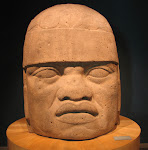
The flowering of the Olmec Civilization occurred between 1500 B.C. to 1000 B.C., when over twenty-two collosal heads of basalt were carved representing the West African Negritic racial type. This flowering continued with the appearance of "Magicians," or Shamanistic Africans who observed and charted the Venus planetary complex.
These "Magicians," are said to have entered Mexico from West Africa between 800 B.C. to 600 B.C. and were speakers of the Mende language as well as writers of the Mende script or the Bambara script, both which are still used in parts of West Africa and the Sahara.
Journeys by ship along the coast of West Africa toward the North, through the Pillars of Heracles, eastward on the Mediterran to Ports such as Byblos in Lebanon, Tyre or Sydon would have been two to three times as lengthy as taking a ship from Cape Verde, sailing it across the Atlantic and landing in North-Eastern Brazil fifteen hundred miles away, or Meso America about 2400 miles away. The distance in itself is not what makes the trip easy. It is the fact that currents which are similar to gigantic rivers in the ocean, carry ships and other vessels from West Africa to the Americas with relative ease.
The Olmec homeland is characterized by swampy lowlands punctuated by low hill ridges and volcanoes. The Olmec response to this environment was the construction of permanent city-temple complexes. The best-known Olmec centers are at San Lorenzo Tenochtitlán, La Venta, Tres Zapotes, Chalcatzingo, and La Mojarra. The Olmec were the first Mesoamericans to develop a hieroglyphic script for their language, the earliest known example dating from 650 BC.
The Olmec practiced shamanism. They believed each individual has an animal spirit. Olmec religion centered around the Shaman. "The feared and revered shaman would conduct rituals and heal the sick." Some believe that the sun was a part of their worshipping along with the jaguar.
The jaguar was a very important figure to the Olmec. "To the ancient Indians the jaguar was a symbol of supernatural forces-not a simple animal, but an ancestor and a god." It was referred to as a nahual, which is an animal that is so closely related to a certain man, that if the animal dies, the man will also die.
The Olmec were brought up believing the Great Serpent was a divine power that was believed to have brought prosperity and growth. When the Olmec first settled around the volcanoes, they noticed the dried up lava that there were resemblances to their Great Serpent, the Olmec farmers took these large basalt boulders and carved them into monuments, for example the colossal heads, and placed them in their maize fields.
Although no remains have been found of any person of the Olmec civilization, researchers have learned how they were laid to rest. After the master dies, he was laid to rest in a special burial mound in the middle of the ceremonial court. He was placed in there adorned with earrings, beads , and necklaces made of jade. Over the body, a layer of thick cinnabar red putty in the shape of an oval was spread over him with thirty-seven serpentine and jade celts. This site was then decorated on top with jewels and other decor.

However, only traces of human remains have been found. "The authors posit that the Olmecs believed that the human body, itself, and espescially that of the ruler, divided itself and represented the three cosmic levels: the celestial or heavenly, the terrestrial, the earth’s surface and the watery underworld, reachable through caves and sacred accesses."


.jpg)









 Posts
Posts


.jpg)



